PEAR in Practice: A Framework for Human Factors in Aviation Maintenance
Human Factors training is a requirement to be reckoned with. But the training itself does not have to be complex, an unfortunate expense, or even a burden. What if there existed a framework which offers four key considerations for a successful Human Factors programme?
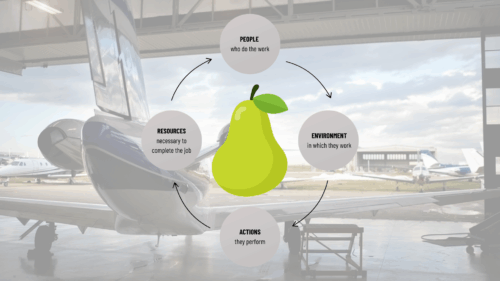
In this article, we dive into PEAR. A model which can be applied to training programmes by emphasising the People who do the job, the Environment in which they work, the Actions they perform, and the Resources necessary to complete the job.
PEAR: What the Letters Mean
Human Factors programmes contribute to reducing errors in the operational environment – and complement the design of an organisation’s Safety Management System (SMS).
Read more: Safety Management: Examining the Four Pillars of SMS
But how can organisations successfully develop an efficient and useful programme for addressing and dealing with Human Factors?
One legitimate approach is applying the components of the PEAR Model. PEAR acts as a mnemonic to help aviation professionals identify and consider four key elements when designing efficient Human Factors training:
- P is for the People who do the job
- E is for the Environment in which they work
- A is for the Actions they perform
- R is for the Resources necessary to complete the job
We are not going to unfold all aspects of the four components in this article. Instead, we want to highlight some of the issues associated with the people, their environments, their actions, and the available resources.
Applying PEAR in Practice
PEAR was developed by Dr. William B. Johnson and Dr. Michael E. Maddox as a framework for identifying and mitigating human error and risk in the maintenance environment.
So, how can you apply the key elements of PEAR in practice?
The P in People calls for the need to address physical, physiological, psychological, and psychosocial factors. A strong Human Factors programme should therefore consider elements such as:
- Natural differences in physicality and human limitations
- Mental and physical health and fatigue
- Interpersonal communication and cooperation
The E in Environment distinguishes between the physical workplace and organisational environment that exists within the company – the Human Factors programme should pay attention to both environments:
- The physical environment includes weather conditions, workspace, lighting, noise, temperature, and safety
- The organisational environment involves personnel, the size of the company, shared values, and the corporate culture
The A in Action means that the company must analyse all the actions that people perform to complete their respective jobs in a safe and efficient manner. Considerations must be made in terms of:
- Knowledge, skills, and attitude requirements
- Job task analysis focusing on task steps, sequence of activities, and the personnel involved
The R in Resources implies that the people, the environment, and the actions dictate the necessary resources. A resource is anything a technician or pilot needs to get the job done. PEAR focuses on identifying the need for additional resources:
- Tangible resources include tools, equipment, and manuals
- Intangible resources include number of people, allocated time, and communication culture
Read more: The Dirty Dozen: Why Cutting Corners Jeopardises Safety
PEAR in SMS
Essentially, PEAR helps organisations identify considerations and issues associated with their Human Factors programme. But according to Johnson and Maddox, PEAR has an even broader scope. The potential hazards and risks which the programme identifies should be an integral part of the organisations’ Safety Management System.
“(…) a maintenance human factors program does not have to be complex, expensive or a burden to the organization. Simply apply PEAR to identify human factors issues and facilitate your efforts to develop and support your safety management system.” (Johnson & Maddox, 2007)
In other words, PEAR is not only a practical tool for improving Human Factors programmes. It also supports SMS by providing a structured approach to hazard identification and the definition of mitigation actions.
Source of inspiration:
Johnson, W. and Maddox, M. (2007). A Model to Explain Human Factors in Aviation Maintenance. Avionics News, April 2007, page 38-41. https://skybrary.aero/sites/default/files/bookshelf/1482.pdf
