5 Ways Airlines Can Make CRM Training More Effective
Crew Resource Management plays a vital role in developing and reinforcing the non-technical skills that contribute to safe flight operations. Communication, teamwork, decision-making, leadership, and situational awareness are competencies that influence how crews respond to challenges, procedures, and unexpected situations.
While aviation authorities such as EASA, CASA, and the FAA establish CRM training requirements within their respective regulatory frameworks, compliance alone does not guarantee effective learning. The real value lies in how effectively training translates into safe operational attitudes and behaviours.
For airlines and CRM trainers, this raises a natural question: How can we ensure that CRM training does more than reinforce knowledge and instead becomes a relevant, meaningful, and engaging learning experience?
In this article, we explore five ways to make training more engaging, relevant, and effective. Without compromising regulatory requirements.
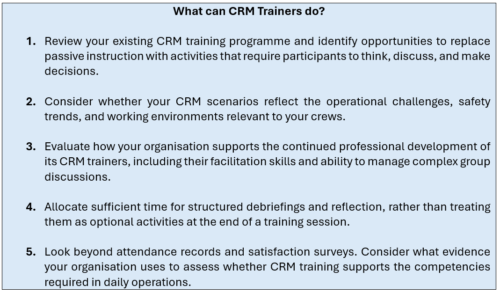
1. Move from passive instruction to active participation
CRM is fundamentally about human behaviour. When it comes to developing and influencing human behaviour, we need to incorporate an interactive element. Traditional classroom instruction rarely suffices.
Instead of relying solely on PowerPoint presentations, accident reports, and flow charts, CRM trainers can use group discussions, role-playing exercises, and scenario-based activities that encourage crew members to actively explore different perspectives, challenge assumptions, and reflect on their own behaviour and experiences.
The objective of active participation is not to agree on one correct answer, but to encourage critical thinking and enhance crew members’ understanding of the factors that influence human performance.
2. Connect training to the real world
One of the most effective ways to make CRM training meaningful is to establish a clear connection between what is presented in the classroom and the realities of the operational environment.
While generic examples can illustrate theoretical concepts, realistic scenarios can reflect the challenges crews encounter during daily operations.
Airlines should consider incorporating crew experiences, anonymised safety reports, incident analyses, and realistic scenarios that reflect their organisational environment.
Read more: Five Benefits of Scenario-Based Aviation Training
Scenario-based training gives crew members opportunities to share experiences, discuss concerns, and practise decision-making in a controlled and safe learning environment.
These in-training discussions become particularly valuable when crew members can relate them to their own operational experiences.
Crew members have first-hand knowledge of the operational environment. Their insights, alongside safety and operational data, can inform an airline’s Safety Management System (SMS), helping to identify recurring human factors issues, potential training gaps, and opportunities for continuous improvement.
3. Invest in the trainer
Socrates, the ancient Greek philosopher, is believed to have uttered these words: “I cannot teach anybody anything. I can only make them think.”
In a modern aviation-related context, the CRM trainer plays a vital role in delivering effective, engaging, and meaningful CRM training.
A CRM trainer must possess strong interpersonal skills, technical understanding, and the ability to facilitate learning, encourage reflection, manage group dynamics, and create a supportive learning environment.
A skilled trainer must be able to constructively navigate, balance, and challenge sensitive discussions about leadership, communication failures, and human error. Without creating a hostile environment. Equally important is the trainer’s ability to recognise when a discussion offers an opportunity for deeper learning and reflection.
These skills do not develop overnight. They require airlines to invest continuously in the professional development of their CRM trainers.

4. Make reflection and feedback part of the process
For a CRM trainer, it is easy to get lost in regulatory requirements and training syllabi.
These are important. But to consolidate the learning, structured reflection and constructive feedback are crucial.
Reflection and feedback allow crew members to examine their decisions, explore different perspectives, and identify areas for improvement. This is particularly relevant in scenario-based CRM training, where participants’ decisions may be influenced by their experience, assumptions, and interpretation of the available information.
A well-facilitated debriefing can help crew members explore what went well, what could have been handled differently, which information and assumptions influenced their decisions, how communication and teamwork affected the outcome, and what they might do differently in a similar situation.
Most importantly, feedback should be constructive, specific, and focused on behaviours rather than personal characteristics.
Read more: Examining the Scope of Formative and Summative Assessments
5. Evaluate the effectiveness of the training
CRM training is an important regulatory requirement, but the tick mark alone tells us little, if any, about the effectiveness of the training.
To gain more actionable insights into training effectiveness, airlines should consider multiple sources of information, such as:
- Crew feedback and safety surveys
- Trainer observations and assessments
- Performance checks
- Recurrent training needs and competency gaps
- Relevant operational safety data
For example, if reports repeatedly address challenges relating to crew communication during high-pressure situations, this may provide valuable information for new CRM training content and teaching methods.
However, it can be very complex to assess changes in non-technical skills. Operational performance is often influenced by a multitude of factors, and therefore airlines should always look at the whole picture.
The objective should therefore be continuous improvement rather than demonstrating effectiveness through a single measure of success. Improving CRM training does not necessarily require more content, longer courses, or more complex training programmes.
By encouraging active participation, connecting learning to operational realities, investing in trainer competence, strengthening reflection, and evaluating effectiveness, airlines can create training experiences that offer value beyond the classroom.